


Ours has been called the “anti-social century,” marked by “spiritual crisis.” Among young Americans, time spent physically with friends fell 70 percent from 2003 to 2020. The share of Americans who report having three or fewer close friends has nearly doubled since 1990, while the share of children who meet friends daily has halved. Men who watch television spend seven times more time in its unblinking company than in the company of blinking humans. Women with pets spend more time with them than with fellow political animals.
It’s not just a hit on health and happiness—it’s a political phenomenon, too. In 2016, Yoni Appelbaum wrote that Trump appealed more to the “disconnected” than the “disaffected.” His article was based on a survey that found civically disengaged Republicans were considerably more likely to support Trump.
Michael Bender followed some of Trump’s most fanatical supporters. Many of them—people who trailed Trump from one rally to the next—were retired and had “little to tie them to home.” Reviewing the book, Michelle Goldberg concludes that a “socially healthy society would probably never have elected Trump in the first place.”
Derek Thompson, in his landmark essay on loneliness, devotes a section to “your politics on solitude.” In her 2023 Atlantic piece, titled “The Weaponization of Loneliness,” Hillary Clinton describes how Steve Bannon activated an army of “rootless white males.” “We’re enmeshed in some sort of emotional, relational, and spiritual crisis, and it undergirds our political dysfunction and the general crisis of our democracy,” writes David Brooks. “For people who feel disrespected, unseen, and alone politics is a seductive form of social therapy.”
They build on a prestigious lineage. Alexis de Tocqueville thought associations—formed to establish seminaries and schools, build inns and churches, administer hospitals and prisons—were the lifeblood of American democracy: “In democratic countries the science of association is the mother science.” Associations transform isolated, weak men, powerless against despots, into a powerful collective. “Americans of all ages, all stations in life,” he observes, “are forever forming associations.”
In the shadow of the Holocaust, Hannah Arendt, William Kornhauser, and Theodor Adorno attributed fascism to atomization and alienation. Adorno observed that a fascist radio host appealed to Americans suffering “despair, isolation, and loneliness.” People “available” to mass movements, explains Kornhauser, are those with “the fewest ties to social order.” Arendt is even clearer: totalitarian movements are “mass organizations of atomized, isolated individuals.” “The chief characteristic of the mass man”—the fanatic, the fascist—“is not brutality and backwardness, but his isolation and lack of normal social relationships.” The movement acts as an ersatz community, a “fictitious home,” the externalization and projection of the disoriented. Loneliness is “the essence of totalitarian government.”
Robert Putnam brought this story into the 21st century. Associations “broaden the participants’ sense of self.” The groups do not have to be political; even a choral society or bird-watching club can teach “an appreciation for the joys of successful collaboration.” Neighborly communities, once cradles of social trust, now wither.
But Trump supporters are not particularly alienated. Appelbaum based his conclusion on a single poll without any controls. A poll taken a few months later found no relationship. A 2025 poll again found no relationship between number of close friends and support for Trump. Even the poll Appelbaum used weakly supports his conclusions: Trump was more popular among Republican disconnected voters, but across parties, a larger share of disconnected voters favored Clinton than Trump.
Perhaps it’s not a matter of individual loneliness but of community cohesion. Andrés Rodríguez-Pose, Neil Lee, and Cornelius Lipp test this theory. They measure cohesion using a composite index that includes, among other things, labor unions, sports clubs, and golf courses per capita. Putnam should expect that less cohesive counties, all else equal, experience a bigger Trump swing.
But no. Communities that most swung toward Trump—those experiencing employment and population decline—are “precisely those where social capital—the very form of capital that, according to Putnam (2000), was supposed to provide the glue for America’s democratic institutions—has held stronger than elsewhere.”
On December 18, 1931, Werner Willikens, a prominent Nazi, was elected to a newly created fourth seat on the presidium of Germany’s largest agricultural organization. The Reichslandbund (RLB) had well over a million members, linked by local offices, agricultural newspapers, and professional staff.
The following spring, in the second round of the presidential election, the RLB openly supported Hitler. In November, its managing president joined a petition calling on President Hindenburg to appoint Hitler chancellor. When Hindenburg appointed General Schleicher instead, the RLB mounted a campaign against his government, in close coordination with Nazi officials.
Willikens’s election was the product of systematic Nazi infiltration. In August 1930, Richard Darré, Hitler’s agricultural advisor, began constructing the Agrarian-Political Apparatus, or ApA. Darré described it as “a weapon” to be employed “with utmost force in agrarian-political wars”—really, a network of Nazi farmer-whisperers.
Darré instructed advisors to “regard every non-National Socialist organization . . . as a fortress to be conquered.” In 1929, the party had forbidden Nazis to join the RLB. The RLB was closely connected to the established nationalist right, a political rival of the Nazis. But after the Nazi electoral breakthrough, Darré concluded the RLB was of more use captured than killed. Hitler called on Nazi farmers: “Into the Landbund!”
In November 1931, Darré met with the RLB director, dubiously claiming more than half of the Landbund’s members were Nazis. He threatened to form a competing Nazi agricultural association. By the end of the meeting, Nazis had been promised a seat on the presidium; Willikens was elected six weeks later.
Historian Horst Gies argues that the Nazi-infiltrated RLB helped persuade Hindenburg to appoint Hitler—making Darré’s ApA one of the most important political machines behind Hitler’s rise. Hitler, in a letter to Darré, expressed a similar belief: “The incorporation into our movement of the millions who made up the German peasantry . . . contributed substantially to creating the conditions for National Socialism’s legal conquest of power in Germany.”
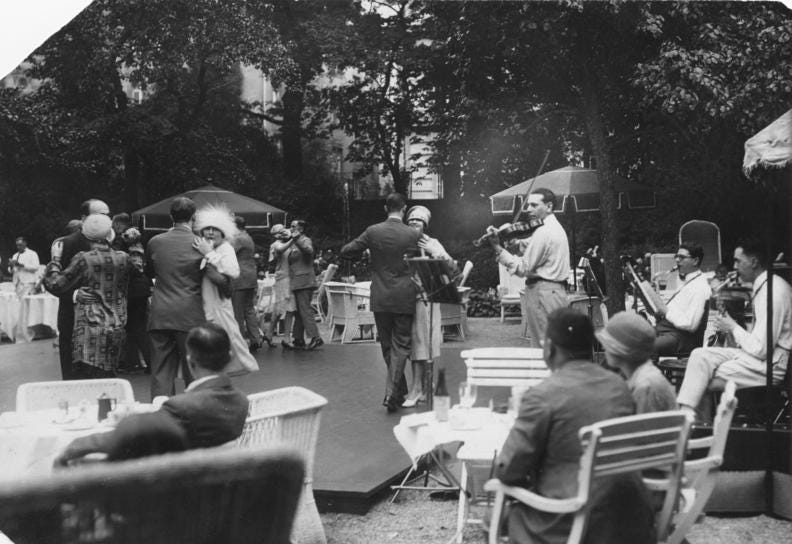
The associational life of Weimar Germany, writes Sheri Berman, was “extraordinarily vigorous.” The Germans had a word for it, naturally: Vereinsmeierei, roughly associational “fetishism” or “mania.” Retailers, bakers, gymnasts, singers, and folklorists all assembled into clubs. Contemporaries joked that if three Germans met at a bar, they began drafting bylaws.
These networks did not protect against fascism—they helped facilitate it. At a moment when institutions were young and weak, the “vigor of associational life . . . served to further undermine and delegitimize the republic’s political structures.” The groups offered an alternative to national political parties; they “created a sense of purpose and transcended socioeconomic divisions.” The fragmentation of political power across small parties is often noted, but there was a symmetric vertical fragmentation; even successful parties had only a loose hold on coalitions of subparty organizations. “The result,” writes Berman, “was a highly organized but vertically fragmented and discontented society that proved to be fertile ground for the Nazi’s rise.”
These groups not only weakened national parties but also provided an opening for disciplined outsiders. This is the point of the RLB story. Put simply, it’s easier to organize a society of several hundred organizations than 65 million individuals. Nazis were “an unusually activist bunch” who exploited the latent political power of the associations. They came to power “not by attracting alienated, apolitical Germans, but rather by recruiting highly activist individuals and then exploiting their skills and associational affiliations.”
After Hitler became chancellor, these same organizations enabled his rapid consolidation of power. The RLB leader—who expected influence in the regime he helped bring about—resigned after Nazi newspapers accused him of speculation. The Gestapo arrested the leader of agricultural cooperatives—which had proven hard to capture without state power—and Darré seized control by threat of force. By September 1933, all agricultural groups were either dissolved or folded into the Reich Food Estate, headed by Darré personally. The entire agricultural web: united, subjugated, and instrumentalized.
Social alienation is not good for democracy—what is unhealthy for a person is usually unhealthy for a polity. But social connectedness is not straightforwardly good for democracy either.
What matters for democracy is a certain kind of social life—the kind that assembles into stable national politics. Associations that transcend political boundaries are depolarizing. That’s good—so long as they don’t undermine the efficacy of the national system. Robust associations connected Germans across party and class, but they failed to create a national equilibrium. They eroded national parties and created a new path to power. Through associations, and on high.
It feels plausible: Nazis as lonely people, lost in a newly industrialized world, searching for meaning in uniform. Trump voters, too: lonely and lost, voting for their man, but voting alone. I want it to be true. I’m sure Arendt and Adorno did too. Then these expressions, these sick expressions of sick societies, whether clad in Hugo Boss or drenched in gilded extravagance, would be different from ordinary politics. If only.