


Andy: I have a headache, I’m seeing double, I have a song stuck in my head and I’m hungry.
Nurse (Anne): Okay, well, some of those things are symptoms and some of them are just being a person.
(from Parks and Recreation)
It’s common among certain journalists and academics to read Adorno to understand Trump. He is after all among the most important theorists of fascism. Adorno I mean not Trump.
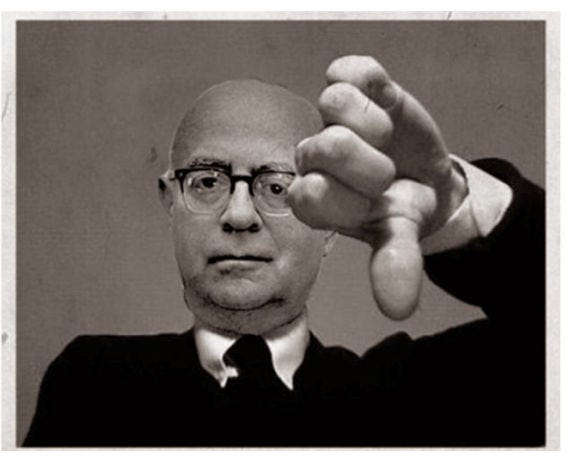
In the half-nation of West Germany Theodor Adorno transcended the detached stature of most theorists. Jewish, born in Frankfurt, Adorno returned from American exile in 1949. He was a staple guest on radio shows, speaking of music and popular culture but with most urgency of the cause and meaning of fascism. He helped forge a German identity around institutions over blood, an Americanized nationalism: and became therefore “the postwar conscience of Germany.”
Psychological Technique is Adorno’s analysis of Martin Luther Thomas—radio host, pastor, fascist, man of many hats. Adorno dissects the patterns of his speech and the causes of his appeal.
I must say my reading shed little light on fascism. It shed light instead on the limits of social philosophy, at least as practiced here.
The problem is it’s not clear what is distinct to fascism. Adorno accuses the radioman of presenting his listeners with a “fait accompli”, as if his political movement has already won. This serves the fascist’s purpose because people would like to be part of a winning movement. Fine. But a different Martin Luther—Martin Luther King—insisted the arc of history bends towards justice. This too declares inevitability. “We’ve got a shot” doesn’t ring the same.
In several places it’s easy to recognize Trump. The radioman often spoke of having no institutional backers. He stewed in the politics of nostalgia. Most resonantly, Adorno reports the pastor weaponized aversion “to any kind of expertness.”
But claiming financial independence is a feature of anti-institutional politics left right and center. Nostalgia politics—the last “A” of MAGA—is conventional conservatism. And anti-expertise was common among the American left after the Vietnam War.
Psychological Technique feels astrological: it’s a long list of descriptions that makes projection easy.
The same is common in analyses of Trump. A 2019 article used this very book to compare Trump’s rhetoric to the radioman’s. A 2025 study classifies Trump’s tweets by which fascist tendency they exemplify (promoting American manufacturing, for instance, evidences a fascistic cult of tradition).
If the first problem is the lack of a control, the second problem is falsifiability.
The theory Adorno develops in Psychological Technique is a contrast of rationality: fascist propaganda is rational—even ingenious—while fascism itself is irrational. Fascist leaders are “psycho-technics”; there’s a “shrewd soberness behind the drunken words.” The fascist crowd, in contrast, is irrational. They hope to cure loneliness and resentment by trading autonomy for collective release (a desire incubated, Adorno explains, by industrial society dislocating and suppressing the individual). Since fascism could never actually cure those feelings, fascism is irrational.
It all sounds true and that’s half the problem. It feels like Adorno is describing an aesthetic: the efficiency and order—the “rationality”—of German Nazis, contrasted by the mass hysteria (“irrationalism”) that carried them. An aesthetic can’t be tested.
(Adorno once debated Popper on falsifiability in science.)
The book is useful as a document of a particular fascist. But without a control, without falsifiability, it infinitely describes and infinitesimally explains. It’s a portrait, an aesthetic characterization, not to be confused with science.