


The march to fascism: 1922, the nation’s second-most-circulated newspaper has published antisemitic propaganda for 91 issues straight.
1924. A national hate group—which aims to solve the Jewish question, if necessary by elimination—boasts millions of members. Signs appear outside social clubs: “No Jews, Dogs, or Consumptives”. Universities erect quotas.
1929. The Great Depression hits as hard as anywhere. Industrial production halves, unemployment reaches 25 percent.
1938. The most prominent religious leader in the country broadcasts to millions. In his first broadcast after Kristallnacht, the priest explains that Jews are “a powerful minority in their influence; a minority endowed with an aggressiveness and initiative.” Most citizens partly blame Jews for the persecution of Jews.
Except fascism never comes. This is the United States.
America had economic collapse, organized racial violence, mass antisemitism, radio demagogues, and protofascist organizations—why did the center hold?
Daniel Ziblatt offers one explanation. German fascism succeeded partly because extremists captured the country’s mainstream conservative party and drove out moderates. Once a barrier against fascism, the party became the bridge to it.
The collapse of the institutional right as a direct cause of German fascism.
Reichstag, June 27, 1922. The chamber’s dark wood paneling adorned by wreaths of red roses and blue hydrangeas. A plain oak coffin. In it Walter Rathenau: liberal, scholar, Jew, the nation’s foreign minister, assassinated by nationalist antisemites. Deputies from all sides, communists and monarchists alike, dressed in solemn black.
If democracy comes in moments, this is one of them.
Two years after the funeral, Weimar entered a four-year “golden age”. Cabinet turnover slowed, currency stabilized. The right-wing party, the DNVP—founded as a monarchist opponent of Weimar—behaved as a mainstream conservative party. It entered coalition governments. Half of its deputies supported a reparation plan, heresy among nationalists. Most strikingly, the officially still monarchist party supplied decisive votes for legislation banning monarchist organizations.
The erosion of the institutional right opened the way to Hitler.
Between 1928 and 1930, the DNVP’s vote share fell from 14 to 7 percent. Nazi support moved the other way, from 3 to 18 percent. About a third of 1928 DNVP voters supported Nazis two years later, and Nazi support grew most where the DNVP declined most.
DNVP leaders also legitimized Nazis. In 1929—with Hitler’s party still marginal—the DNVP included Hitler as equal partner in a national campaign against reparations. In 1931, the DNVP organized a nationalist rally at which 70,000 SA men displayed fascist military discipline.
The DNVP’s electoral collapse and radical turn made a center-right coalition acceptable to President Hindenburg impossible. Presidential governments increasingly ruled by emergency decree. A few years later, Hitler would do the same.
The DNVP had once functioned as a “border party”, keeping potential radicals attached to parliamentary politics. It had become a bridge to fascism.
The German right was structurally vulnerable to capture.
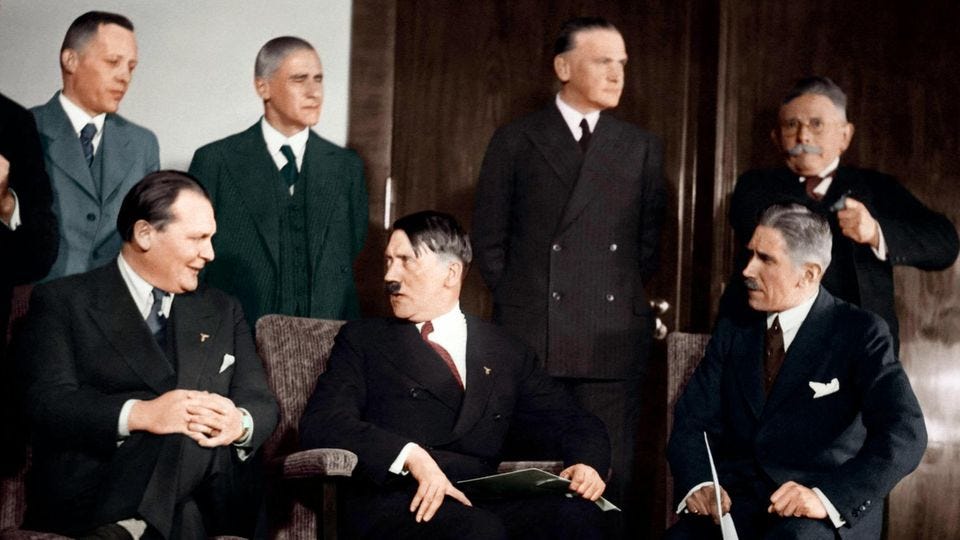
Heinrich Class led the ultranationalist Pan-German League. Alfred Hugenberg was an industrial executive and media magnate who controlled Germany’s largest private news agency. Incensed by the party’s moderation, they staged a takeover.
Power lay with 45 regional associations, which set candidate lists and elected the party chairman. Many were underfunded and lacked mass participation. Class had the people: his Pan-German League had around 16,000 disciplined members. Hugenberg had the capital: he controlled at least 30 percent of the DNVP’s 1928 spending. In October, Hugenberg was elected chairman unopposed.
Hugenberg quickly consolidated power. He replaced moderate regional leaders, threatened to expel dissenting deputies, and asserted the authority to dictate parliamentary votes. His radical turn alienated core elements of the party’s coalition, accelerating the DNVP’s electoral collapse.
Limits of the argument
Hugenberg did not initiate the DNVP’s decline; its support had already fallen from 21 percent in 1924 to 14 percent in 1928. Nor can the causal direction be cleanly inferred: the DNVP’s collapse created space for Nazism, and Nazism accelerated the DNVP’s collapse. And the opening did not necessarily have to benefit extremists—under different conditions, it could have been filled by moderates.
American protofascists never acquired a common political vehicle.
Perhaps 100,000 Americans belonged to explicitly anti-democratic organizations during the 1930s. The KKK enrolled several million earlier in the interwar period. Father Coughlin retained millions of listeners even after his broadcasts became openly antisemitic and sympathetic to Hitler. Antisemitism extended further: even in the late 1930s and 1940s, 10 to 15 percent of Americans favored severe measures against Jews, and more than half of Americans partly blamed Jews for their own persecution. Yet these constituencies never assembled into a common political movement.
Roosevelt retained much of the potential insurgent constituency.1
Huey Long and Father Coughlin were the most formidable American populists of the interwar period. Both advocated extensive economic intervention and redistribution, militantly opposed communism, and commanded enormous followings.
Yet they had a “single, debilitating weakness”: the “inability to wean their followers from Franklin Roosevelt”.2 Half of survey respondents who approved of Coughlin in 1936 reported voting for Roosevelt.3
The New Deal appropriated some of their most salient arguments. In proposing a more graduated tax plan, President Roosevelt was partly motivated by “stealing Long’s thunder”. FDR’s utility regulation and monopoly-busting competed with Long and Coughlin’s polemics against economic concentration.
White supremacists also found an institutional home in Roosevelt’s Democratic Party. Agricultural and domestic workers—disproportionately Black—were excluded from New Deal protections to accommodate Southern Democrats. White supremacists remained integrated into the national party. In 1936, Roosevelt won 87 percent of the vote in Georgia, 97 in Mississippi, and 99 in South Carolina.
The strength of Roosevelt’s hold on the populist electorate was never fully tested: Huey Long was assassinated before an anticipated 1936 campaign.
The Republican Party was difficult to capture.
The Republican Party was in trouble. In 1932, Roosevelt swept 42 states and Democrats won three-quarters of House seats. Democrats again defied political gravity in the midterms. 1936 was worse yet: FDR carried all but two states, while Republican congressional representation fell under 20 percent. Republicans were sidelined from national politics and nearly broke—the RNC ended the 1934 campaign with $352 in liquid assets.4
Father Coughlin sensed opportunity. In May 1936, Coughlin said he hoped for “a renovated Republican Party” of “contrite heart”. Hoover aides, eager for his anti-Roosevelt legions, approached the priest (some, however, were wary: one aide warned that encouraging Coughlin was “playing with nitroglycerin”). The romance was short-lived. Alf Landon, a bitter opponent of Coughlin’s financial program, won the nomination.5
Why didn’t Coughlin attempt a takeover of the Republican Party? Whatever his reasons, orchestrating a takeover would have required an organization Coughlin did not have.
The Republican Party offered no single point of capture. The representatives who chose the RNC chair were selected through 53 separate state and territorial party systems. The presidential nominee was chosen by convention delegates. Delegates emerged from a state-by-state patchwork of primaries, caucuses, conventions, and committees. Legislative candidates were generally selected through direct primaries. Party authority was therefore divided among state organizations, primary voters, and the RNC.
Scale was also forbidding. More than 3.3 million voters participated in the 1936 Republican presidential primaries—five times the DNVP’s entire membership—even though those contests selected only about a third of convention delegates. A national insurgent had to compete both for a mass primary electorate and within state party processes.
Coughlin had millions of listeners and a loose political association. But he did not have Class’s disciplined ideologues, cadres embedded in state parties. Nor did he have Hugenberg’s extraordinary wealth. And the Republican Party would have been a far grander target than the DNVP.
Nor could Coughlin bypass the major parties.
After Landon won the Republican nomination, Coughlin quickly endorsed William Lemke, the candidate of the new Union Party. Despite Coughlin’s enormous audience, Lemke secured just 2 percent of the national vote. The structural domination of two parties has been a persistent fact of the American system: plurality elections, ballot access laws, and the Electoral College reinforce the pressure to organize within major parties. Unlike Weimar’s proportional system—where roughly 60,000 votes could yield a Reichstag seat—an American radical movement unable to capture a major party was likely to remain marginal.
When he took over Weimar’s largest right-wing party, Alfred Hugenberg was not popular. His ascension may have been a fatal blow—a rational and self-interested party would have spit him right back out.
But a party is as it is constituted. The DNVP was constituted as a confederation of regional associations. With a little dedication and a lot of resources, these associations could be controlled. Once captured, the party ceased containing the radical right and began legitimizing it. Hitler had waited long enough to get lucky: the depression, the right’s collapse, the fragmentation, Hindenburg’s imprudence.
In October 1935, Sinclair Lewis, pen in hand, imported fascism to America. It took little imagination. His antagonist is unmistakably Huey Long. The priest who legitimizes and endorses the fascist is a renamed Father Coughlin. The book’s title: It Can’t Happen Here.
It could, of course, and that was Lewis’s point. But it didn’t. It didn’t because of the enormity of Roosevelt’s coalition. It didn’t because of the mundane complexity of party machinery. The left accommodated, and the center held.
James Sundquist, Dynamics of the Party System (1983); Alan Brinkley, Voices of Protest (1982)
Brinkley
Bromhead & O’Rourke, Should History Change the Way We Think About Populism? (2024)
Clyde P. Weed, The Nemesis of Reform (1994)
Donald Warren, Radio Priest (1996)